How to come up with a memorable name for a moving company.
The average moving company in the US runs four trucks or less. That means there are a lot of moving companies, and you’re going to figure that out the moment you start naming yours: every name you like is already taken.
So this isn’t a brainstorming exercise. It’s a filtering exercise. Here’s the process: what not to do, how to clear a name properly, which word goes after it, and how to let the market pick the winner instead of you.
What not to do
Rule 1: never reuse an existing name
Not a variation of it, not a slightly different spelling. If that company grows into a multimillion-dollar operation, you get a cease and desist letter.
And then what happens? Your uniforms, your truck wraps, your boxes, your signage, all of it wasted. Rebranding is brutally expensive, and you eat that cost at the exact moment you can least afford it.
Rule 2: stay away from the big players
Avoid any liability with a big company, especially a publicly traded one that is still doing well. They have lawyers on retainer and a budget you cannot match.
The Lime Movers problem
Say you want to be Lime Movers. Sounds clean, easy to remember, nobody in your market is using it. But Lime, the scooter company, holds a trademark in transportation.
Everything is fine until one day it isn’t. You get a letter, and fighting that thing can run real money.
End up with 3 to 6 names, all of them clear
Your goal is at least three names, up to six. Every single one has to be fully cleared and ready to use. These are not candidates you’re hoping will survive. They all go into the vote at the end, which means whichever one wins, you can start using it the next morning.
So this isn’t a funnel where you throw in six and hope two make it. If a name fails a check, it’s out and you replace it, then run the replacement through the same checks from the top. You keep doing that until you have three to six names you’d be happy to put on a truck tomorrow.
Fewer than three and the vote isn’t really a choice. More than six and it gets mushy. Run every name through the two checks below, in this order. Cheap check first.
Check 1: Google it
Quick search on each name. You’re looking for any match, and specifically you want to stay out of the moving business and the trucking business in the US. Those are the industries where a conflict actually bites you.
If a mover or a carrier anywhere in the country is already using it, cross it off and move on. Don’t negotiate with yourself about how different your market is.
Outside the US doesn't count
A company outside the US that doesn’t operate in the US is fine. You can use that name. If you find a mover in Australia or a haulage company in the UK with your name, and they have no US presence, it isn’t your problem.
Trademark rights are territorial, so a business that doesn’t trade here isn’t in a position to come after you here. What you’re screening for is a US mover, a US carrier, or a foreign company that actually operates in the US. Everything else on page one is noise.
Check 2: Run it through USPTO
If the name survives Google, next stop is tmsearch.uspto.gov/search. You search your main word, not the full name. If you’re Lime Movers, you search “lime”.
Search the main word as a wordmark
Just the distinctive word, not the full company name.
Check live registrations and pending
Pending counts, because it becomes live.
Filter to class 39
That's the transportation class, and it's the only one that really concerns you.
You’re going to find a lot of companies holding a wordmark on your word. That alone isn’t a problem. What you’re checking is whether class 039 is registered for that trademark. Somebody owning “lime” for soft drinks is not your fight.
If you do find your word registered in class 039, go look at their website and ask one question: how likely is it that a customer confuses you with them?
Lime Movers, green, with a lime as the logo
Lime scooters are green and use a lime. You launch green, using a lime. That’s the confusion case, handed to them on a plate.
Lime Tree Movers, different green, different mark
A completely different palette, a completely different mark, a completely different feel. Different enough that nobody mixes you up.
This is the operator’s version of a clearance search, not legal advice. If a name looks close to a live class 39 mark and you still want it, pay a trademark attorney for an hour before you print anything.
The word after your name is just as important
Lime Movers, Lime Moving and Storage, Lime Moving Services. These are not the same name, and the one you pick has consequences.
- MoversBestWhat the overwhelming majority of people actually type. Narrow, specific, unambiguous.
- Moving ServicesSecondStill fine. Slightly broader, slightly less searched.
- Moving and StorageThirdDilutes the brand. Signals storage as a headline service when it isn't your lead offer.
- Moving and TransferDon'tSame dilution problem, and almost no search demand behind it. Skip it.
- RelocationDon'tShouldn't be in consideration in the first place.
- Moving and LaborOutside playIf you've got the nerve for it. Not the safe pick, but it's honest about what you sell.
You might look at that list and think moving and storage is the way to go, since it sounds bigger and more established. My recommendation: don’t dilute the name. People are searching for movers. Once they find you, you get your chance to sell them storage, or whatever comes next.
You offer a pile of services: local, long distance, loading somebody’s pod, unloading somebody’s pod, storage. There’s no sense singling out the storage business in your company name. You’ll still get storage customers, because your website says you do storage. It’s just not worth diluting the brand name over.
Your company name should be narrow and specific about the main service and shouldn’t confuse the initial offer. Be clear about the one thing you do, and let the website carry the rest.
Let 20 people pick the winner
Now you’ve got a shortlist that’s clean. Put those names into a Google Form and ask people which moving company they’d choose based on the name alone. Send it to a bunch of friends. You want at least 20 responses before you read anything into the result.
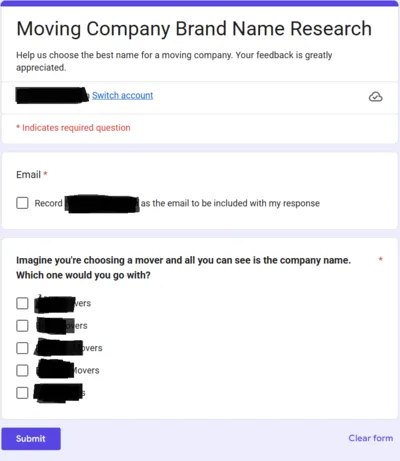
What not to do here
Don’t ask people to rank their first choice, second choice, third choice. Don’t score points.
If you do that, the most average name wins: the one that’s everybody’s second or third pick but nobody’s favorite. That’s the exact opposite of memorable.
And don’t put any graphics in the form. No logos, no colors, no fonts. The whole idea is that people choose against the name and nothing else.
One vote. That’s your name.
The reason this works: it’s not about what you like. It’s about what the general population, the people you’re actually going to sell to, actually likes.
If you’ve done this before and you trust your gut, this step isn’t necessarily for you. But if you’re just starting out and you’re not sure, you cannot go wrong running the vote.
That's your company name
You have a winner
It cleared Google, it cleared class 39, it uses the word people actually search, and 20+ strangers picked it over the alternatives without seeing a single pixel of branding.
Congratulations. Go register it, and don’t reopen the decision. One thing left before you print anything: the domain.
Now go get the domain
You’ve got the name, so now you want the URL to match it. What you’re after is the exact one: limemovers.com. Work down this list in order and stop at the first one that gets you a .com.
Search the exact .com at a normal registrar
Start at godaddy.com or namecheap.com. If it’s unregistered, buy it now and you’re finished.
If it's taken, check the resale market
Try atom.com, where people sell domains they already own. Yours might be sitting there.
If the price stings, lease it to own
Resale domains usually run $1,000 or more. If you really want that exact one, Atom lets you lease to own: monthly installments for up to a year, and at the end the domain is yours.
If it's taken or too expensive, add a prefix
getlimemovers.com or mylimemovers.com. Cheap, available, and still a .com.
Buy it yourself, in your own name
Never let your developer register the domain for you. Not as a favor, not to save you ten minutes. The registrar account has to be under your email, with your card and your login.
Add the developer as an administrator or delegate so they can get at the DNS settings and do their job. That costs you nothing. But if the domain sits under their email, they own the single most important asset in your business, and that is enormous leverage over you.
It stops being theoretical the day you want to switch developers, or the relationship goes bad, or they simply stop answering. Your website, your email, and every lead flowing through them are on the other side of a login you don’t have.
Don't take a different extension
Stay away from .us, .movers, and the rest of them. The domain isn’t the real cost here. Your email is.
People automatically assume you’re a .com. Anything else means you spend the rest of your life spelling out your own email address on the phone, and correcting people who already sent something to the .com by mistake.
you@limemovers.us
“No, not .com, it’s dot U S.” You explain it on every single call, and you still lose the ones who don’t listen.
you@getlimemovers.com
A prefix costs you one extra word. A different extension costs you a correction on every call and every business card.
A .com also tends to earn better search performance over time, because it’s the address people type, link to, and click without hesitating. Don’t confuse the client and don’t spend money and breath explaining an extension. Just get the .com.
The short version
- Never take a name already used in US moving or trucking. Rebranding after a cease and desist costs more than the name ever saved you.
- Avoid any big, healthy, publicly traded company's mark. They don't need to win, they just need to outspend you.
- End up with 3 to 6 names that are all cleared and ready to use. If one fails a check, replace it and clear the replacement.
- Google each one. A company outside the US with no US operations doesn't block you.
- Search the main word on USPTO as a wordmark. Live and pending, class 39. If it's there, judge likelihood of confusion.
- Use “Movers.” Not “Moving and Storage.” Never “Relocation” or “Moving and Transfer.”
- Google Form, 20+ people, one vote each, no ranking, no graphics. The winner is the name.
- Get the .com. GoDaddy or Namecheap first, Atom (with lease to own) if it's taken, a get- or my- prefix if it's too expensive. Never .us or .movers.
- Register the domain under your own email and card. Add your developer as an administrator, never as the owner.